Key Features
1. Quick-Change Forming Parts System for Rapid Product Transition
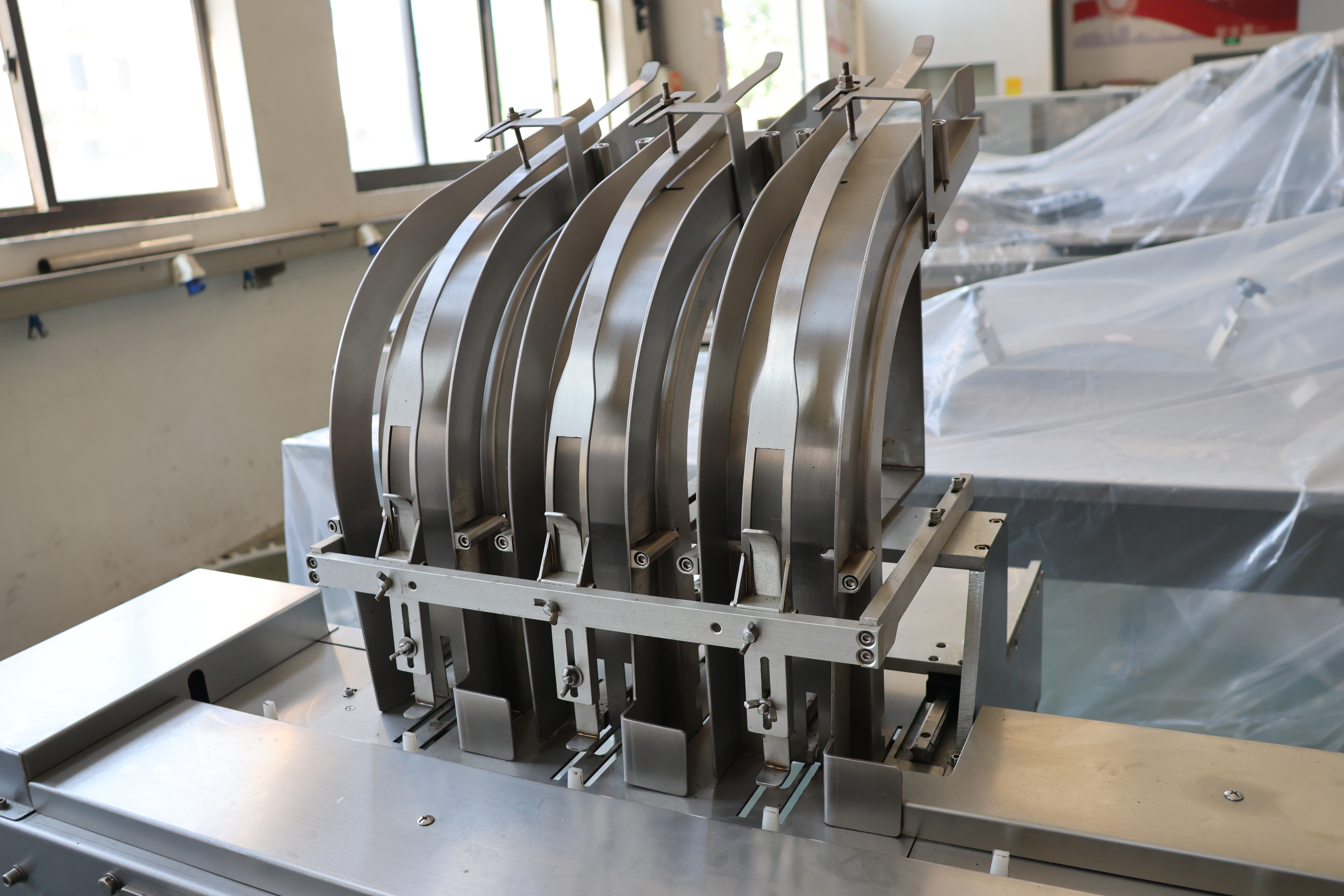
The JY-FW200's quick-change forming parts system is the engineering feature that enables the machine to wrap products ranging from small soap bars (30 mm length, 15 mm width) to large cake slices (250 mm length, 80 mm width) on the same equipment without the 30-to-60-minute mechanical changeover that conventional single-purpose wrappers require when transitioning between different product dimensions. The system consists of three interchangeable component sets: the forming collar set (four standard collar sizes covering the full product width range from 10 mm to 80 mm, plus custom collars for non-standard dimensions), the infeed conveyor guide rail set (adjustable rails that can be repositioned without tools using the HMI-controlled servo actuators, setting the correct conveyor lane width for each product type in under 2 minutes), and the alignment bracket set (removable brackets that position the product centring mechanism for the correct product height and shape profile). Each component set is mounted on quick-release brackets with spring-loaded locking pins — a design borrowed from industrial tool-changing systems — that allow the operator to remove a component with one hand and install a replacement in under 60 seconds per component. A complete forming-parts changeover (all three component sets) takes under 10 minutes from start to finish, compared to 30 to 60 minutes on conventional machines where the operator must loosen bolts, adjust positions with wrenches, and manually measure the new product dimensions against the machine settings. The quick-change system also eliminates the measurement errors that manual changeovers introduce: each forming collar, guide rail position, and alignment bracket has a pre-set dimension that corresponds to a stored product recipe on the HMI, and when the operator selects the recipe and installs the matching components, the machine is automatically configured for the correct product dimensions without any manual measurement or adjustment. This recipe-and-component matching approach reduces the reject-bag count during changeover from hundreds (typical on conventional machines) to fewer than 15, because the machine starts producing acceptable packages almost immediately after the component swap.
2. Servo-Driven PLC Control with Multi-Product Recipe Library
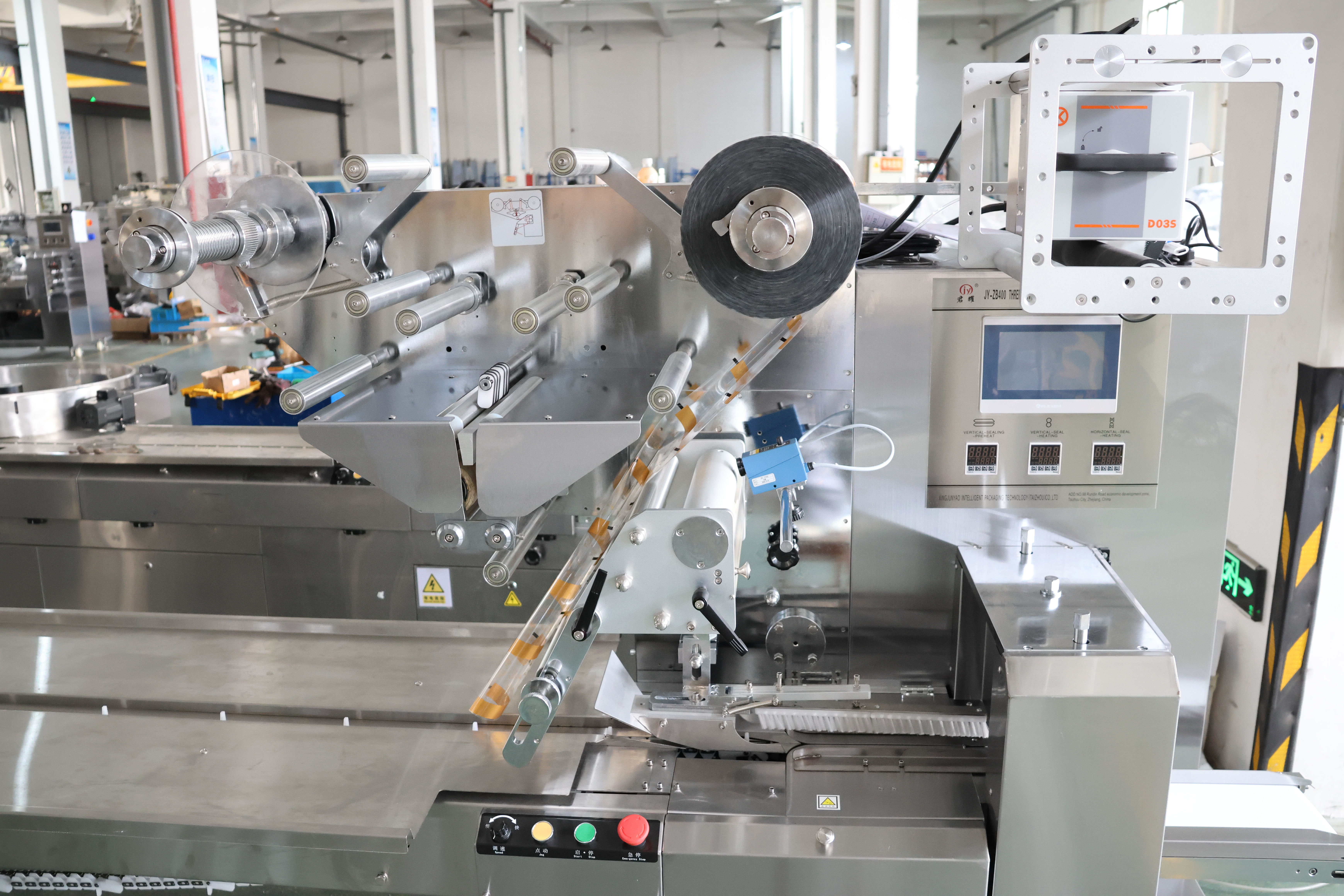
The JY-FW200 employs a servo-driven PLC control system with an HMI touch-screen interface that stores up to 50 product recipes covering the full range of product types, dimensions, and film specifications that the machine can accommodate. Each recipe contains a complete machine configuration: servo speed settings for the infeed conveyor, the film feed drum, the longitudinal seal roller, and the cross-seal rotary knife; seal temperature settings (adjustable from 100 to 200 degrees Celsius for the longitudinal seal and the cross-seal); seal pressure actuator positions; cross-seal dwell time; infeed conveyor lane width (controlled by servo actuators); photoelectric registration sensor calibration parameters; and the forming collar size assignment that tells the operator which physical collar to install for the selected recipe. When the operator selects a recipe on the HMI — for example, "Rectangular Cake Slice 150x60mm OPP/PE Film" — the PLC simultaneously adjusts all servo speeds, all seal temperatures, all seal pressures, the infeed lane width, and the registration sensor parameters, completing the electronic configuration in under 2 minutes. The operator then swaps the physical forming collar and alignment brackets to match the recipe's collar assignment, completing the mechanical configuration in under 8 minutes. The total changeover time from recipe selection to first acceptable package is under 10 minutes, with fewer than 15 reject bags. This recipe-driven changeover approach transforms the JY-FW200 from a single-product machine into a multi-product platform that can produce 5 to 10 different product types in a single 8-hour shift, enabling small-batch manufacturers to respond to diverse customer orders without maintaining a fleet of single-purpose packaging machines.
3. Wide Product Compatibility — Food and Non-Food Categories
The JY-FW200's multi-purpose design extends beyond dimensional versatility to encompass product categories that conventional food packaging machines cannot accommodate. Most horizontal flow wrappers are designed exclusively for food products, with product-contact surfaces that meet food hygiene standards but are not optimized for the physical characteristics of non-food items such as soap bars, which have different surface friction, different moisture content, and different chemical compatibility requirements. The JY-FW200 addresses this cross-category challenge through a dual-surface infeed conveyor system: one set of conveyor belts uses food-grade silicone rubber surfaces certified under EU Regulation 1935/2004 for food product contact, and a second set of conveyor belts uses industrial-grade PTFE-coated surfaces that resist the alkaline residue left by soap bars and the oil residue left by personal care product containers. The operator selects the appropriate conveyor belt set when switching between food and non-food production runs, swapping belts in under 5 minutes using the quick-release belt tension mechanism. This dual-surface approach ensures that the food-grade belts never come into contact with soap residue, maintaining the food hygiene integrity required for CE-marked food product packaging, while the PTFE belts provide the chemical resistance and low-friction surface that soap and personal care product packaging demands. Beyond food and soap, the JY-FW200 can package small hardware items (bolts, brackets, fasteners) in sealed pillow packs for retail display, using the PTFE conveyor belts and a heavier seal pressure setting that accommodates the thicker industrial-grade polyethylene film commonly used for hardware packaging. The machine's wide product compatibility — from soft cake slices to hard soap bars to metal hardware pieces — makes it a genuinely multi-purpose platform that serves manufacturers across multiple industry categories with a single equipment investment.
4. Adjustable Sealing Parameters for Diverse Film Structures
The JY-FW200's cross-category product compatibility demands a correspondingly wide range of film sealing parameters, because the film structures used for cake packaging (OPP/PE two-layer laminates sealing at 130 to 150 degrees Celsius), biscuit packaging (single-layer PP sealing at 110 to 130 degrees Celsius), soap packaging (thick PE monolayer sealing at 150 to 180 degrees Celsius), and hardware packaging (industrial-grade PE sealing at 170 to 190 degrees Celsius) differ significantly in their sealing temperature, pressure, and dwell time requirements. The JY-FW200 longitudinal and cross-seal units feature independently controlled heating elements with PID temperature controllers that maintain each zone within plus or minus 2 degrees Celsius of the set value across the full 100-to-200-degree range. Seal pressure is regulated by servo-driven actuators with adjustable positions that can be set from light pressure (for thin food-grade films that must not wrinkle) to heavy pressure (for thick industrial-grade films that need deeper melt penetration). The cross-seal dwell time is adjustable from 0.1 to 0.5 seconds, and the PLC calculates the optimal dwell time for each recipe based on the stored film thickness and structure parameters. The HMI stores all seal parameters as part of each product recipe, and when the operator selects a recipe, the PLC automatically loads the correct seal temperatures, pressures, and dwell times for the corresponding film type, eliminating the manual seal-parameter tuning that conventional machines require after each film change — a process that typically produces 50 to 100 reject bags while the operator searches for the correct combination of temperature, pressure, and dwell time through trial and error.
5. Stainless-Steel Frame with Food/Non-Food Hygiene Separation
Packaging both food products and non-food products on the same machine raises a hygiene concern that the JY-FW200 addresses through a comprehensive food/non-food hygiene separation protocol. The machine frame is constructed from SUS304 stainless steel with all exposed surfaces polished to a Ra 0.8 micro-metre finish, meeting food-industry surface standards. The dual-surface conveyor system described above ensures that food-grade contact surfaces are never exposed to non-food product residue. When transitioning from a non-food production run (soap or hardware packaging) to a food production run (cake or biscuit packaging), the operator performs a hygiene separation procedure that includes: removing the PTFE conveyor belts and installing the food-grade silicone belts (under 5 minutes); wiping down all accessible machine surfaces with a food-safe sanitising wipe (under 5 minutes); and selecting the "Food Mode Hygiene Reset" option on the HMI, which triggers the PLC to log the hygiene transition in the machine's electronic record and display a confirmation message on the HMI screen that the hygiene separation procedure has been completed. This electronic hygiene log provides documented evidence that the machine was properly sanitised between non-food and food production runs, supporting the traceability requirements that food safety auditors expect in CE-marked food production facilities. When transitioning from food to non-food production, the procedure is reversed: the food-grade belts are removed and the PTFE belts are installed, and the machine surfaces receive a standard wipe-down cleaning without the food-safe sanitising requirement. The complete hygiene transition procedure takes under 15 minutes in either direction, enabling manufacturers to switch between food and non-food production within a single shift without the extended cleaning downtime that separate food and non-food machines would eliminate but that a single dual-purpose machine must manage through a disciplined hygiene protocol.
6. Multi-Language HMI with Cross-Industry Product Library
The JY-FW200 HMI touch screen supports English, Chinese, Arabic, Russian, Spanish, French, and Portuguese, covering the official languages of Junyao's primary export destinations in more than 25 countries. All operational menus, alarm codes, parameter labels, and recipe management screens display in the operator's selected language. Beyond the standard interface, the HMI includes a cross-industry product library that categorises the stored recipes into three groups: Food Products (cake slices, biscuits, cookies, chocolate bars), Non-Food Personal Care (soap bars, shampoo sachets, cosmetic samples), and Non-Food Hardware (bolt packs, bracket packs, fastener assortments). Each recipe contains all servo parameters, seal settings, infeed conveyor width, forming collar assignment, conveyor belt type (food-grade silicone or PTFE), and hygiene mode (food mode or non-food mode). The cross-industry categorisation helps the operator quickly identify the correct recipe when switching between product types from different industry categories, and the HMI displays a visual prompt reminding the operator to perform the hygiene separation procedure when transitioning from a non-food recipe to a food recipe. The PLC's Ethernet port connects to Junyao's remote diagnostic platform, enabling the engineering team in Taizhou to access live machine data and recipe parameters via VPN. This remote support is particularly valuable for multi-product manufacturers who may encounter unfamiliar alarm codes or parameter conflicts when first setting up a non-food product recipe after extended experience with food products, as Junyao's engineers can guide the operator through the correct non-food configuration in real time.


 EN
EN