Product Overview
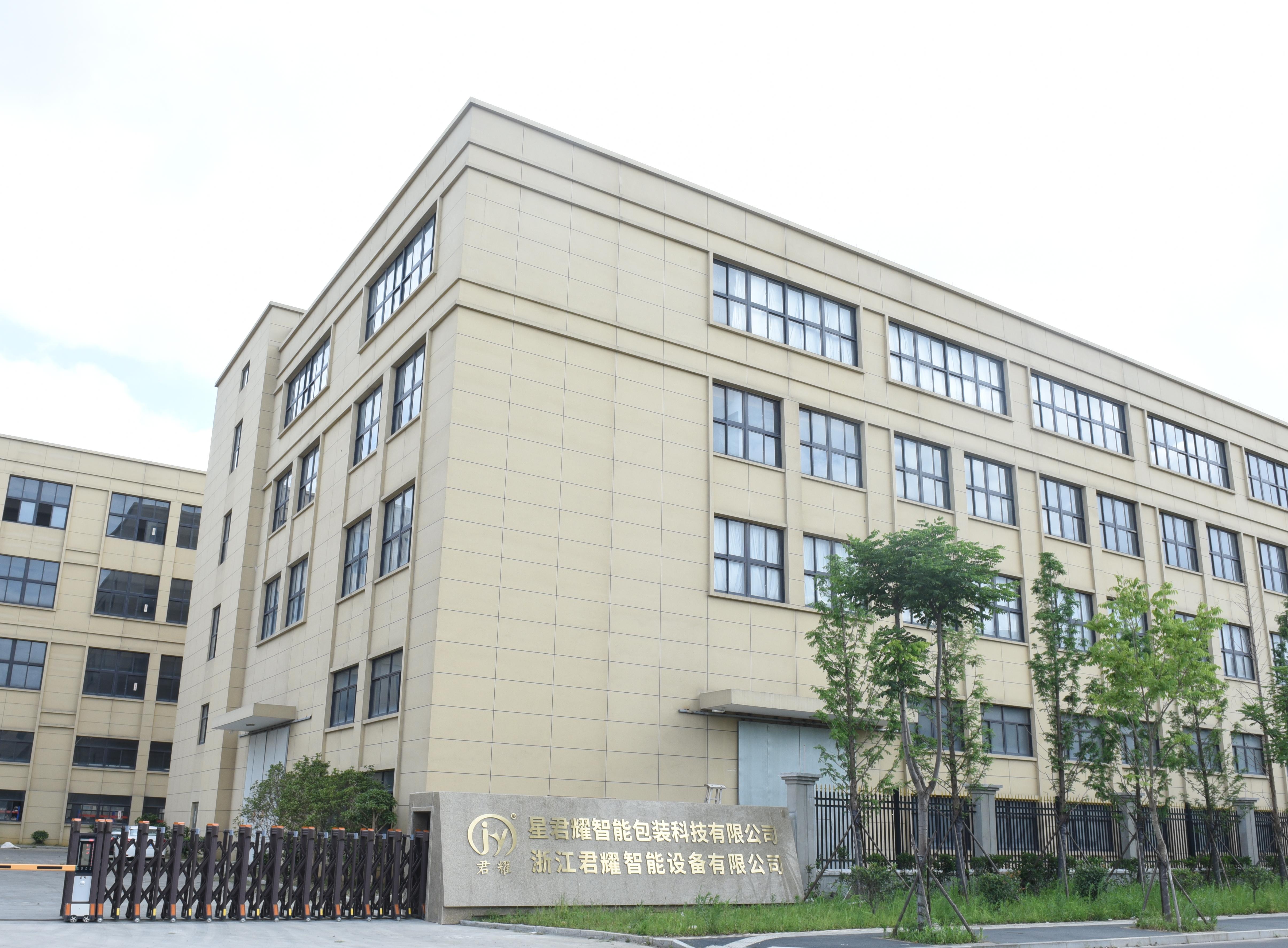
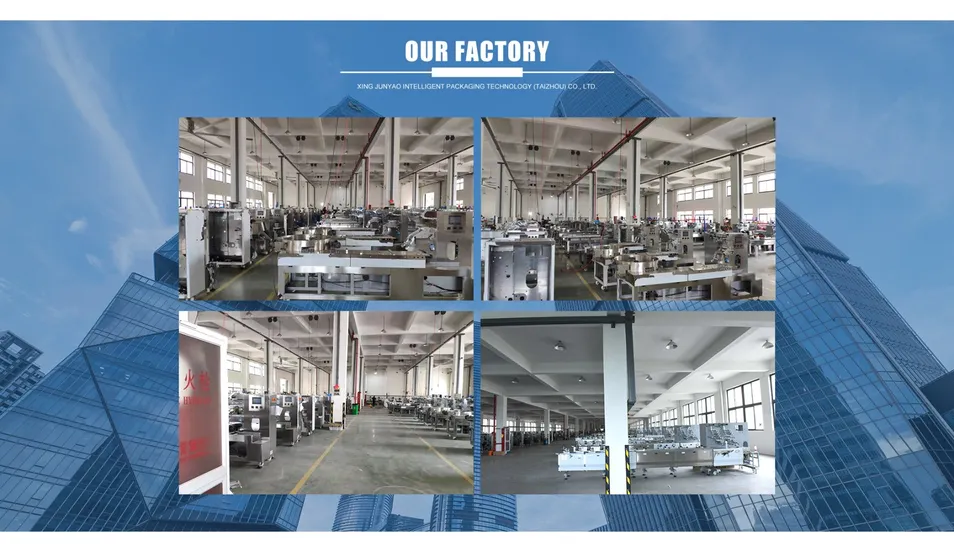
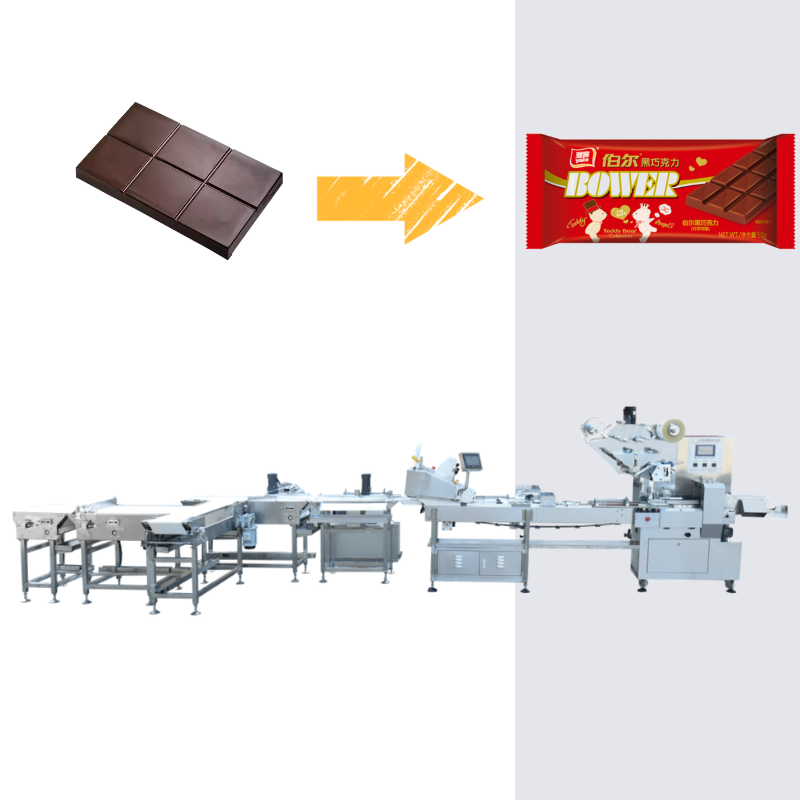
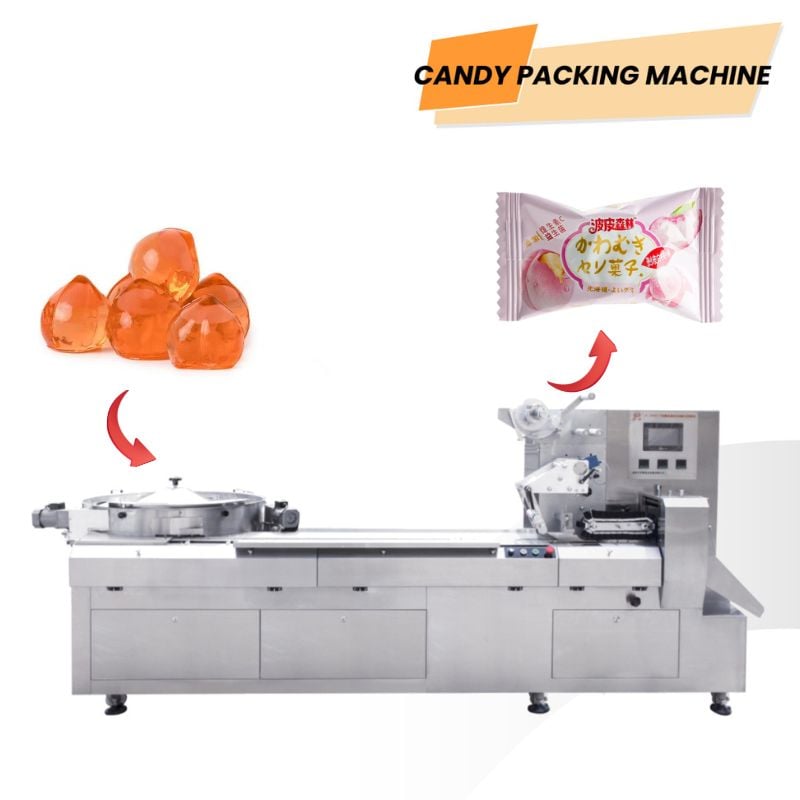
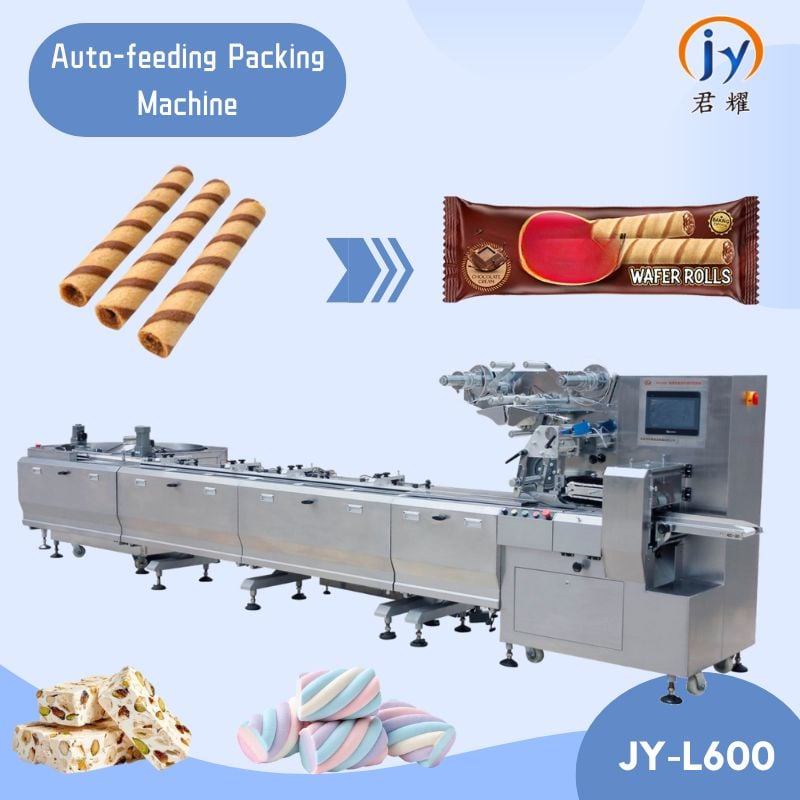
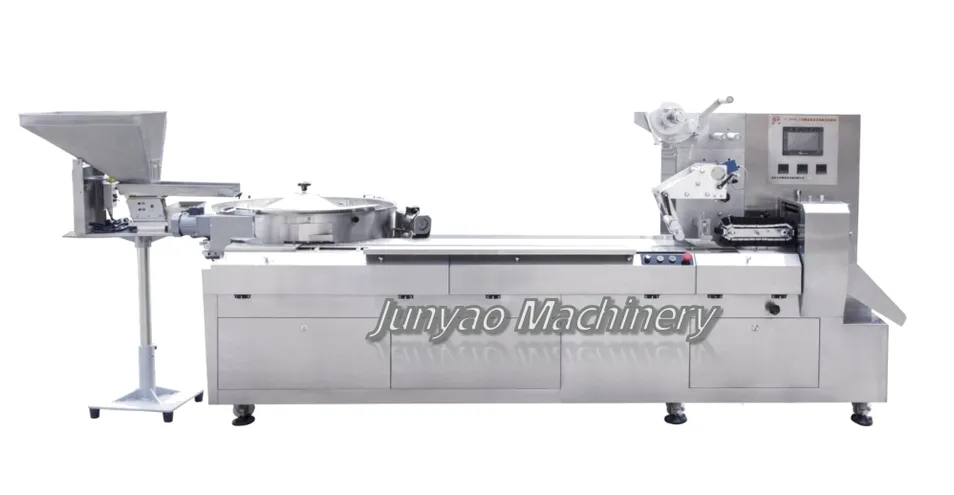
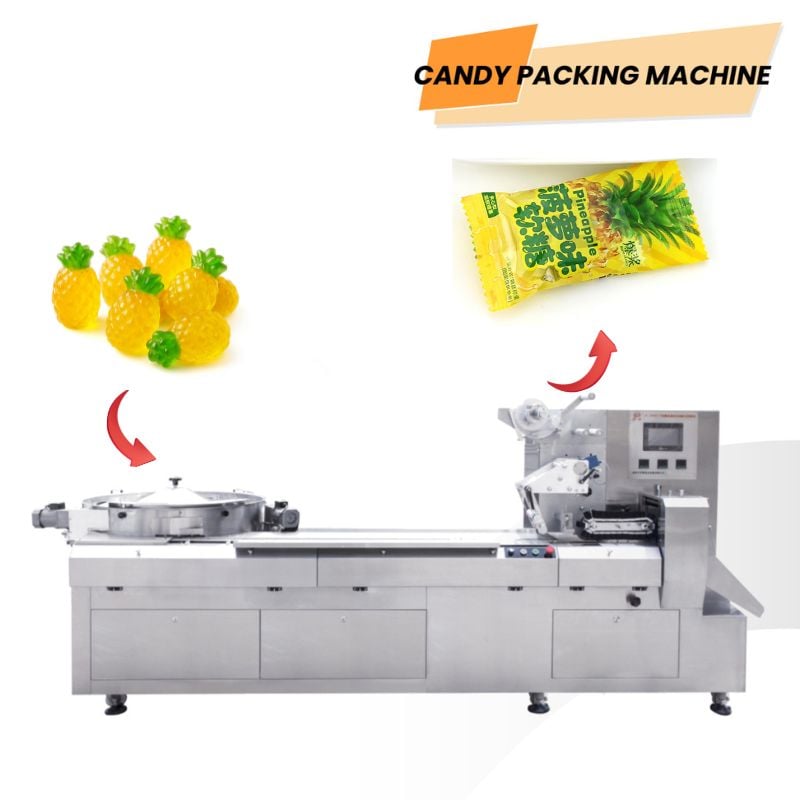
The Junyao JY-ZB600D is a five-servo-driven high-speed pillow packaging and flow wrapping machine engineered specifically for three-dimensional and irregularly shaped gummy candy products that cannot be reliably packaged on standard cylindrical-product wrappers. Designed and manufactured at Xingjunyao Intelligent Packaging Technology's 13,000 m² facility in Taizhou, Zhejiang, the JY-ZB600D addresses a packaging challenge that has grown significantly with the global expansion of novelty and artisan gummy confections: products shaped as hearts, stars, letters, numbers, animals, and other complex moulded forms that present uneven surfaces, variable cross-sections, and inconsistent orientation on the conveyor belt. Standard pillow wrappers with simple forming collars designed for round or rectangular candies struggle with these 3D products because the irregular shape prevents the product from settling into a predictable position inside the film tube, resulting in off-centre seals, wrinkled film, and a finished package that looks unprofessional on the retail shelf. The JY-ZB600D solves this through a special forming collar with an enlarged entry aperture and a contoured internal channel that accommodates the product's three-dimensional profile without compression, combined with an orientation-controlled infeed system that uses a shaped sorting channel to ensure that each 3D gummy enters the forming collar in a consistent pose — whether that means a heart-shaped gummy always entering point-down or a star-shaped gummy always entering with one arm leading.
The JY-ZB600D delivers production speeds from 50 to 600 pieces per minute with a bag length range from 50 mm to 200 mm — an extended range compared to standard gummy wrappers that typically max out at 120 mm, accommodating the longer bag dimensions required by 3D gummies that occupy more axial space inside the pillow pouch than compact round gummies. The machine consumes 5.5 KW of total power and weighs 1000 KG, reflecting the additional servo motors and mechanical complexity required for the 3D-specific infeed orientation system and the special forming collar mechanism. Since Xingjunyao's founding in 2014, the company has exported packaging solutions to more than 25 countries, and the JY-ZB600D incorporates engineering feedback from gummy manufacturers in markets where novelty-shaped confections command premium shelf positions — particularly Southeast Asia, the Middle East, and Europe — where the visual presentation of the individually wrapped product directly influences the consumer's purchase decision at the retail point.
Key Features
1. Five-Servo Coordinated Drive System for 3D Product Handling
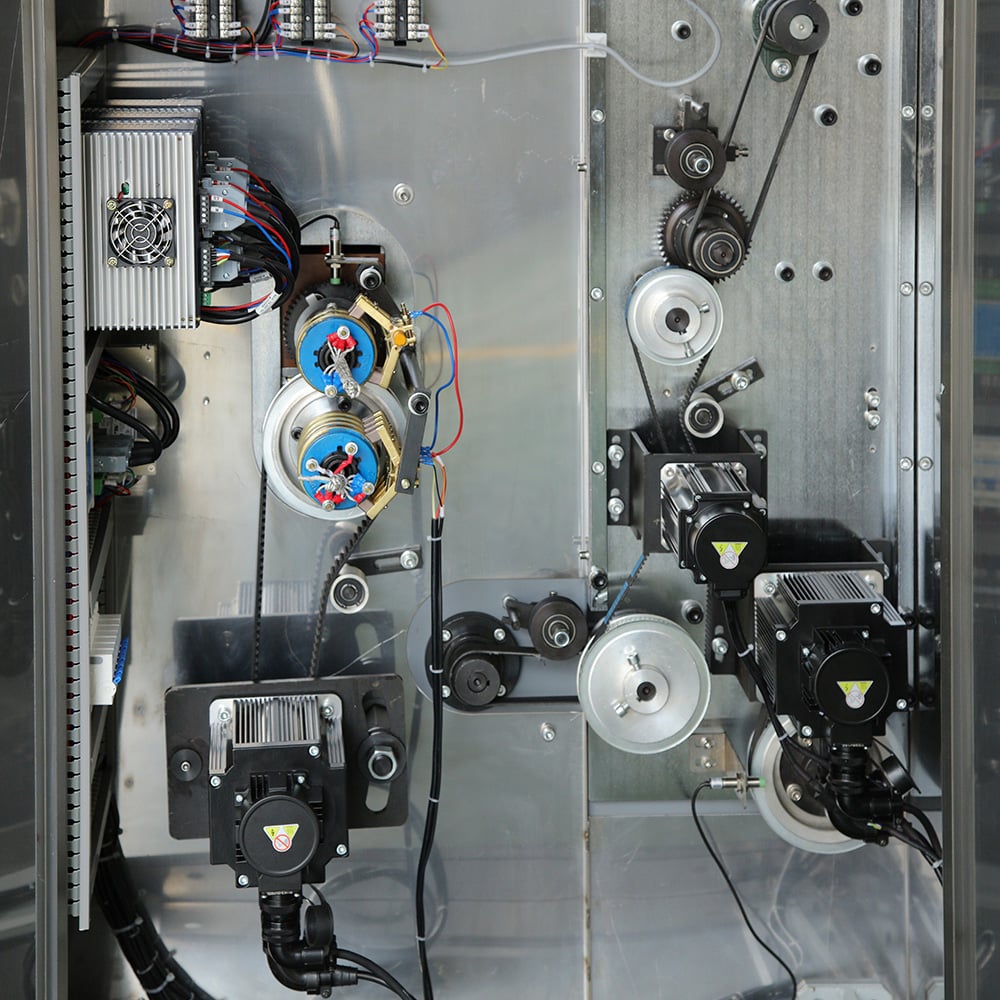
The JY-ZB600D employs a five-servo motor architecture that provides independent control over each critical machine axis: Servo 1 drives the orientation sorting channel rotation, controlling the speed at which 3D gummies pass through the shaped channel that determines their entry pose; Servo 2 drives the infeed conveyor, controlling the spacing between consecutive products as they approach the forming collar; Servo 3 drives the film feeding drum, controlling the film web speed that determines the bag length; Servo 4 drives the longitudinal seal roller, controlling the continuous seal pressure and dwell time; Servo 5 drives the cross-seal rotary knife, controlling the end-seal timing and cut position. This five-servo architecture replaces the three-axle mechanical cam system used on older gummy wrappers, eliminating the fixed mechanical relationships between axes that force the operator to change physical gears and linkages when switching between different 3D product shapes. Instead, all five axes are coordinated through the PLC controller, and the operator adjusts each axis's speed, timing, and position through the HMI by selecting a product recipe — a process that takes under 3 minutes compared to the 30-to-45-minute mechanical changeover required on cam-driven machines. The five-servo design also enables a unique adaptive-speed feature: when the orientation sorting channel detects that a 3D gummy has entered in the wrong pose (detected by a shape-recognition photoelectric sensor), the PLC can momentarily slow the infeed conveyor by 10 to 15 percent to give the next product time to correct its orientation, resuming full speed once the correctly oriented product enters the forming collar. This adaptive speed correction reduces the misoriented-product reject rate from approximately 2 to 3 percent on standard wrappers to less than 0.5 percent on the JY-ZB600D.
2. Special Forming Collar with Enlarged Entry Aperture for 3D Shapes
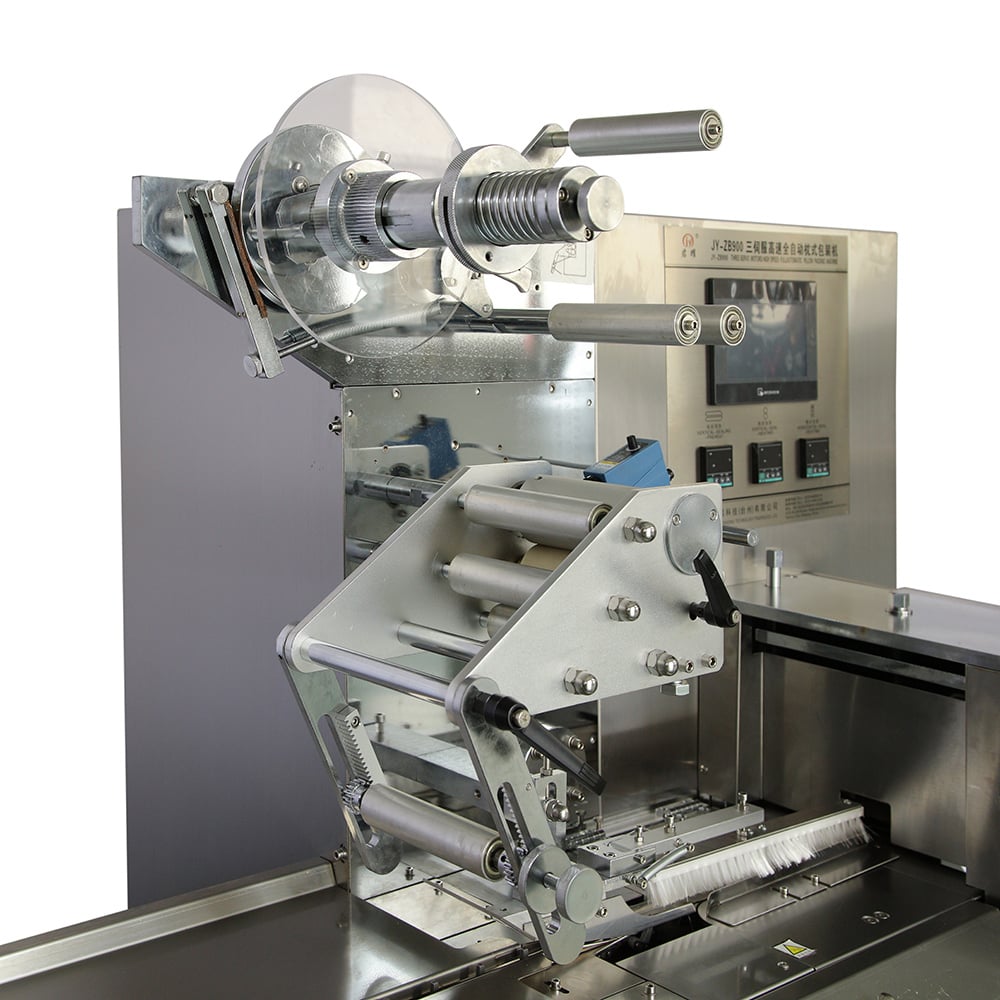
The forming collar — the component that bends the flat film web into a tube around the product — is the most critical element for 3D gummy packaging. Standard pillow wrappers use a forming collar with a rectangular or oval entry aperture sized for the product's maximum cross-section, but 3D gummies present a more complex challenge: their cross-section varies along the product's length (a heart-shaped gummy is wider at the top lobes and narrower at the bottom point), and the product's irregular outline means that a simple rectangular aperture either compresses the wider parts of the gummy or leaves excessive film gap around the narrower parts, producing an uneven bag that bulges at some points and sags at others. The JY-ZB600D uses a special forming collar with an enlarged entry aperture that is 20 to 30 percent wider than the product's maximum cross-section, combined with a contoured internal channel that follows the product's profile from the entry point to the longitudinal seal line. The enlarged aperture allows the 3D gummy to enter the film tube without compression, and the contoured channel gently guides the film around the product's irregular outline, producing a pillow pouch that conforms to the gummy's shape without excess film wrinkling or product deformation. Each 3D product shape requires a specific forming collar contour, and the JY-ZB600D's forming collar is mounted on a quick-change bracket that allows the operator to swap collars in under 5 minutes when switching between different 3D product types. Junyao maintains a library of standard forming collar contours for the most common 3D gummy shapes — hearts, stars, letters, and animal outlines — and can manufacture custom contours for unique product geometries based on the customer's product drawings or physical samples.
3. Orientation-Controlled Infeed with Shape-Recognition Sensor
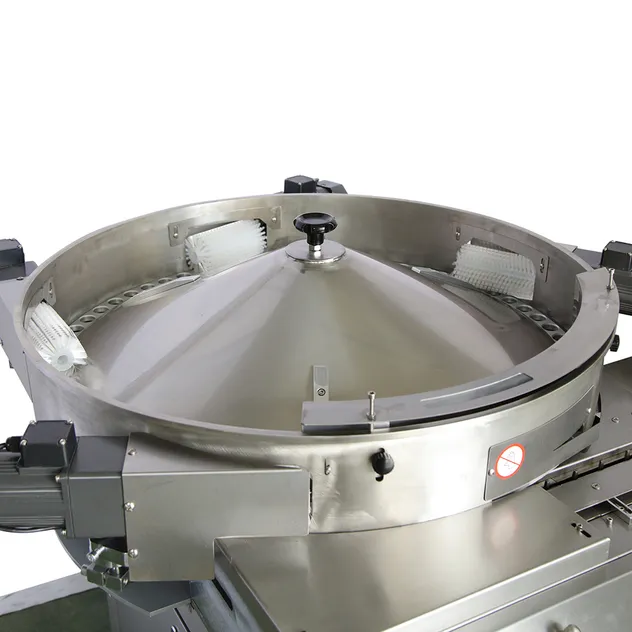
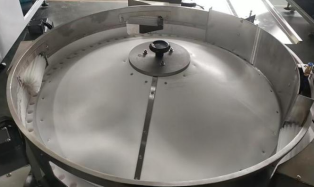
Irregularly shaped gummy candies do not settle into a predictable orientation on a flat conveyor belt the way round or rectangular candies do. A heart-shaped gummy may arrive at the forming collar point-down, point-up, or sideways; a star-shaped gummy may present any of its five arms as the leading edge. This orientation randomness produces two problems: first, the product's appearance inside the sealed bag varies from piece to piece, undermining the visual consistency that premium brands require; second, an incorrectly oriented 3D product may exceed the forming collar aperture in one dimension while fitting in another, causing a jam that stops the machine. The JY-ZB600D addresses this with an orientation-controlled infeed system that consists of three components working in sequence. The first component is a shaped sorting channel — a narrow trough cut into the sorting tray surface that matches the desired orientation of the specific 3D gummy shape. As gummies rotate on the sorting tray, those that happen to align with the channel profile slide into the channel and continue toward the infeed conveyor in the correct orientation; those that are misaligned slide past the channel and continue rotating on the tray until they eventually align. The second component is a shape-recognition photoelectric sensor positioned between the sorting channel exit and the forming collar entry. This sensor uses a dual-beam configuration that reads the product's silhouette as it passes, comparing the measured silhouette profile against the stored reference profile for the active product recipe. If the silhouette does not match — indicating that the product has rotated out of the correct orientation after exiting the sorting channel — the sensor signals the PLC to activate the adaptive-speed correction described above, slowing the infeed briefly to allow the next correctly oriented product to take priority. The third component is a servo-driven orienting wheel positioned just before the forming collar entry. For gummy shapes where the sorting channel alone cannot guarantee 100 percent correct orientation (shapes with near-symmetrical profiles such as letters O or X), the orienting wheel applies a gentle rotational nudging force that rotates the product into the programmed orientation, using the shape-recognition sensor's feedback to determine the direction and magnitude of the nudge. The combined effect of these three components reduces the misorientation rate to less than 0.5 percent at production speeds up to 600 PPM, compared to 2 to 5 percent on standard wrappers without orientation control.
4. Extended Bag Length Range for 3D Product Packaging
Three-dimensional gummy products occupy more axial space inside a pillow pouch than compact round or flat candies. A 25 mm round gummy fits comfortably in a 60 mm bag with 15 mm of clearance at each end, but a 35 mm heart-shaped gummy with its uneven profile requires a bag length of 90 to 100 mm to accommodate the product's maximum length plus adequate end-seal clearance on both the wider top lobes and the narrower bottom point. The JY-ZB600D's extended bag length range from 50 mm to 200 mm covers these requirements, compared to the 45-to-120 mm range on the JY-ZB1200 standard candy wrapper. The extended range is achieved through a longer film feed stroke controlled by Servo 3, combined with a wider cross-seal knife that can accommodate bags up to 200 mm in length without reducing the seal dwell time. At the maximum bag length of 200 mm, the machine maintains a production speed of 50 PPM; at the minimum bag length of 50 mm, the speed increases to 600 PPM. The relationship between bag length and production speed follows a linear approximation: the operator can estimate the achievable speed for any bag length within the range using the formula Speed = 600 - (2.9 x (Bag Length - 50)), where the result is capped at 600 PPM maximum and floored at 50 PPM minimum. This predictable speed-length relationship allows production planners to calculate the machine's output rate for any planned 3D product format before committing to a production schedule, eliminating the uncertainty that characterizes speed estimates on machines with non-linear speed-length curves.
5. Anti-Stick Coated Contact Surfaces and Quick-Clean Design
Three-dimensional gummy products share the same sticky-surface characteristics as standard gummy bears, and the JY-ZB600D inherits the anti-stick coating technology developed for the JY-ZB800G. All product-contact surfaces — the shaped sorting channel, the orientation wheel, the forming collar internal channel, and the infeed conveyor belt — are coated with a food-grade PTFE-modified silicone anti-stick layer that reduces surface friction to less than 0.15 and prevents sticky gummy residue from bonding to machine surfaces even after 8 hours of continuous production. The JY-ZB600D adds a cleaning-specific design feature that the 3D product context demands: the shaped sorting channel and the orientation wheel are more complex in geometry than the flat surfaces on standard gummy wrappers, and residue can accumulate in the channel contours and wheel crevices where a flat wipe-down cloth cannot reach. The JY-ZB600D addresses this by mounting the sorting channel insert and the orientation wheel on quick-release brackets that allow the operator to remove these components in under 2 minutes and wash them in a sink or under a spray hose, while the flat machine surfaces are wiped down with a damp cloth. This combination of quick-release complex components and wipe-clean flat surfaces enables a complete cleaning cycle between flavour or product-shape changes in under 12 minutes, compared to the 30-to-40-minute cleaning cycle required on conventional 3D gummy wrappers that lack quick-release component design.
6. Multi-Language HMI with 3D Product Shape Library
The JY-ZB600D HMI touch screen supports English, Chinese, Arabic, Russian, Spanish, French, and Portuguese, with all menus, alarm codes, and parameter labels displayed in the operator's selected language. Beyond the standard operational interface, the HMI includes a 3D product shape library that stores orientation profiles, forming collar assignments, orienting wheel parameters, and shape-recognition sensor reference data for each product shape. When the operator selects a product shape from the library — for example, "Heart Gummy 35 mm" — the PLC automatically loads all five servo axis parameters, the sorting channel speed, the orientation wheel nudging direction and magnitude, the forming collar aperture setting, and the shape-recognition sensor reference profile. This shape-library approach eliminates the multi-parameter manual setup that 3D gummy packaging requires on conventional machines — where the operator must adjust sorting tray speed, infeed spacing, forming collar dimensions, seal timing, and sensor calibration separately for each new product shape, a process that takes 20 to 30 minutes even for an experienced operator. The shape library currently contains pre-programmed profiles for 20 standard 3D gummy shapes, and new shapes can be added by the operator through a guided setup wizard that walks through each parameter setting step with visual prompts and confirmation checks, storing the new profile for future one-touch recall.
Technical Specifications



 EN
EN