 EN
EN
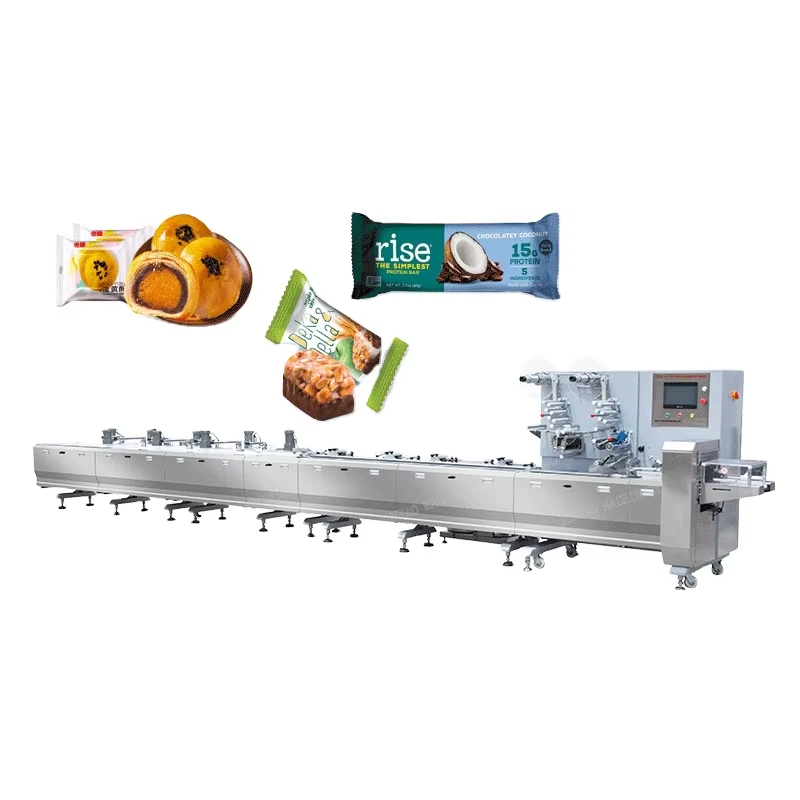
The Flow Wrapping Process: Continuous Motion for Maximum Uptime
Conventional packaging often relies on stop-start cycles—products pause for sealing and cutting—introducing friction that reduces throughput and wastes energy. In contrast, flow wrapping operates on a continuous motion principle: film moves uninterrupted as products feed into the machine. This section explains why stop-start creates bottlenecks—and how continuous sealing eliminates them.
Why Conventional Stop-Start Packaging Creates Bottlenecks
Intermittent wrapping machines advance the product, stop for sealing, then move again. These pauses cap output well below 100 packs per minute. Each deceleration and acceleration wastes energy, accelerates wear on drives and belts, and risks misalignment—leading to jams that require operator intervention. Even a half-second dwell per cycle accumulates to thousands of lost packages over a shift. The bottleneck forces upstream fillers to throttle back, dragging down overall line efficiency. As mechanical components wear, operators must constantly recalibrate timing—adding labor cost and instability. This paradigm inherently limits scalability: growing output typically demands multiple parallel lines rather than a single, higher-performing system—driving up capital expense, floor space, and cost per pack while eroding overall equipment effectiveness (OEE).
How Continuous Motion Sealing Eliminates Cycle Downtime
Continuous motion flow packing machines use rotating seal jaws that move in precise synchrony with the product conveyor. Film is formed, longitudinally sealed, cross-sealed, and cut—all without pausing. This eliminates start-stop inertia, enabling speeds of 300+ packs per minute. Adaptive servo drives maintain exact timing, reducing film waste and peak power demand. The absence of indexing delays delivers a steady, predictable product stream that aligns seamlessly with upstream and downstream processes. Modern systems achieve over 95% uptime—transforming packaging from a bottleneck into a high-speed, stable, and scalable operation. The result is higher throughput, lower operating costs, and simplified capacity expansion.
Key Technical Drivers of Efficiency in Modern Flow Packing Machines
PLC/HMI Control and Adaptive Servo Drives for Precision & Energy Savings
Modern flow packing machines are powered by integrated control systems where programmable logic controllers (PLCs) and intuitive human-machine interfaces (HMIs) enable millisecond-accurate adjustments to seal temperature, film tension, and bag length. Adaptive servo drives replace outdated pneumatic or mechanical clutches, delivering smooth, responsive acceleration and deceleration. This precision reduces stress on packaging film—minimizing tears and misfeeds—while cutting peak energy demand. Industry data shows servo-driven systems achieve cycle times under 0.8 seconds and consume up to 20% less energy than legacy pneumatic models.
No-Product–No-Bag Logic: Reducing Film Waste by Up to 12%
“No-product–no-bag” logic uses infeed sensors to detect gaps in product flow and automatically skip bag formation during empty intervals. This prevents the creation of wasted, empty packages—eliminating unnecessary material use and downstream disposal or recycling effort. In high-volume runs—hundreds of packages per minute—the cumulative savings compound quickly. Real-world implementation consistently reduces film consumption by up to 12%, directly lowering material costs and supporting sustainability targets without sacrificing speed or reliability.
Scalable Throughput: Achieving 30–350+ Packs/Min with Modular Flow Packing Machines
Multi-Lane Configurations Maximize Output Without Expanding Footprint
Modular flow packing machines scale throughput via multi-lane configurations—processing products in parallel within a single footprint. A dual-lane setup effectively doubles output; triple-lane systems reach 350+ packs/minute. Advanced servo controls synchronize all lanes, preserving accuracy and minimizing film waste even at top speeds. Because output multiplies without expanding floor space, capital investment stays lean—especially valuable in facilities with spatial constraints. Independent lane control also enables mixed-SKU runs, while modular architecture supports phased upgrades: manufacturers can begin with one lane for pilot production and add capacity incrementally as demand grows.
Key Benefits of Multi-Lane Systems:
- Space Utilization: +150–200% throughput in same footprint
- Flexibility: Independent lane control for mixed SKU runs
- Scalability: Gradual lane additions match production growth
End-to-End Line Integration: Boosting Overall Packaging Efficiency
Seamless Integration with Fillers, Checkweighers, and Case Packers
Integrating your flow packing machine with upstream fillers and downstream checkweighers and case packers creates a unified packaging line—reducing manual handling, buffering, and transition delays. PLC-driven communication protocols synchronize product transfer directly from filler to wrapper, eliminating accumulation stations and alignment errors while sustaining optimal line speed. Downstream, real-time weight verification from integrated checkweighers triggers automatic rejection of under- or overweight packs—without interrupting the wrapping process. Synchronized case packers receive wrapped products in consistent orientation and count sequences, cutting robotic pick-and-place motions by up to 40%. According to industry studies, fully integrated lines reduce downtime by up to 25% and increase total throughput by more than 40% compared to isolated, siloed equipment.
FAQ
What is flow wrapping?
Flow wrapping is a continuous motion packaging process where film moves uninterrupted as products feed into the machine, enhancing throughput and reducing downtime.
How do flow wrapping machines improve efficiency compared to intermittent ones?
Flow wrapping machines eliminate stop-start inertia, operate at higher speeds, and minimize film waste, resulting in superior uptime and scalability.
How does “no-product–no-bag” logic reduce film waste?
The logic utilizes sensors to detect product gaps, skipping bag formation during intervals without products, significantly cutting down material waste.
Can flow packing systems handle mixed-SKU production?
Yes, modular and multi-lane flow packing machines allow independent lane control, enabling mixed-SKU runs within the same footprint.
Why is end-to-end integration important in packaging lines?
Integration reduces manual handling, aligns upstream and downstream processes seamlessly, and boosts overall throughput and efficiency.