
 EN
EN
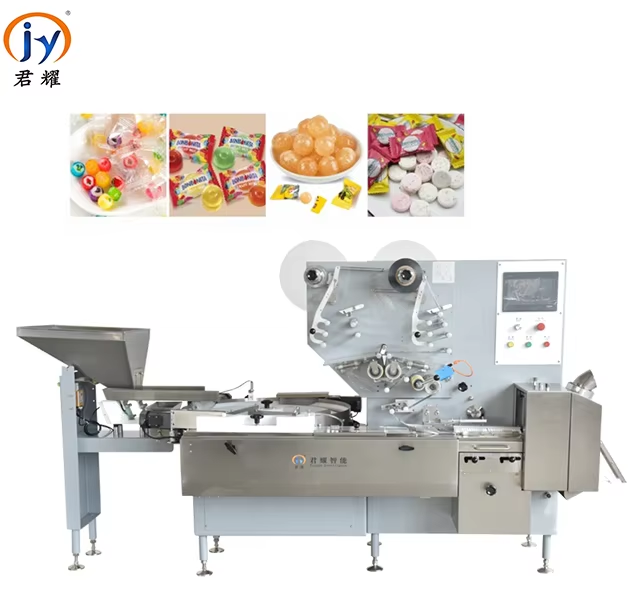
FDA and Food Contact Compliance for Candy Packaging Machines
FDA 21 CFR Requirements for Food-Contact Surfaces and Material Migration Limits
Candy packaging machines must comply with FDA 21 CFR Part 170–189, which governs food-contact substances and sets strict limits on chemical migration from equipment surfaces into candy. All materials contacting product—including conveyor belts, guides, sealing jaws, and film-handling components—must be FDA-approved, such as 304 or 316L stainless steel or food-grade polymers listed in the regulations. Manufacturers are responsible for validating that no harmful substances leach into confectionery under normal operating conditions, including elevated temperatures or prolonged contact times. Migration testing—conducted per FDA-recommended protocols—confirms compliance with established thresholds. Reputable suppliers provide full documentation of material certifications and migration test reports for all food-contact parts, enabling facilities to meet audit requirements and avoid regulatory action, recalls, or liability.
Hygienic Design: Stainless Steel Grades, Smooth Welds, and Clean-in-Place (CIP) Compatibility
Hygienic design is foundational to both regulatory compliance and operational reliability. Candy packaging machines should use 304 or 316L stainless steel for all food-contact surfaces: 304 offers excellent corrosion resistance for general applications, while 316L adds molybdenum for enhanced protection against acidic or saline environments common in flavored or fruit-based candies. Welds must be continuously ground and polished to a Ra ≤ 0.8 µm finish, eliminating micro-crevices where bacteria or sugar residues can accumulate. Sloped surfaces, drip-free joints, and elimination of dead legs or recessed fasteners further prevent product buildup. When paired with Clean-in-Place (CIP) compatibility—featuring sanitary connections, open-frame construction, and validated spray coverage—these features enable rapid, repeatable sanitation without disassembly. This not only supports FDA 21 CFR and FSMA preventive control requirements but also reduces labor, minimizes downtime, and extends equipment service life.
Global Regulatory Certifications Essential for Candy Packaging Machines
CE Marking, ISO 12100 Risk Assessment, and Machinery Directive Alignment
CE marking is mandatory for placing candy packaging machines on the EU market and signals conformity with the Machinery Directive (2006/42/EC), Low Voltage Directive (2014/35/EU), and Electromagnetic Compatibility Directive (2014/30/EU). Achieving this requires a systematic risk assessment per ISO 12100, tailored to confectionery-specific hazards—including sugar dust ignition, sticky product ejection, heat exposure from sealing systems, and pinch points during film tensioning. Based on the assessment, manufacturers must implement appropriate safeguards: interlocked access doors, light curtains at feed hoppers, emergency stop circuits, and thermal cut-offs for heated sealing bars. A complete technical file—including design drawings, risk assessment records, test reports, and the EU Declaration of Conformity—must be maintained and made available upon request. For global buyers, the CE mark serves as objective evidence of rigorous safety engineering and simplifies customs clearance and regulatory acceptance beyond the EU.
FSMA Preventive Controls and USDA-Food Facility Registration Implications
While USDA-FSIS does not regulate non-meat confectionery, U.S.-based candy packaging operations fall squarely under FDA jurisdiction via the Food Safety Modernization Act (FSMA). Facilities must register with the FDA as food establishments and implement a written Food Safety Plan that includes hazard analysis and risk-based preventive controls. The candy packaging machine directly influences several of these controls—particularly those addressing physical hazards (e.g., metal fragments from wear), allergen cross-contact (e.g., shared lines for nut-containing and nut-free products), and sanitation (e.g., cleanability of sealing zones). To support compliance, manufacturers should supply documentation verifying seamless integration with foreign object detection, validated cleaning procedures, allergen changeover protocols, and seal integrity verification. This enables facilities to demonstrate due diligence during FDA inspections and third-party audits—and ensures the packaging line functions as an active component of the facility’s preventive control system.
Integrated Safety Controls Specific to Candy Packaging Machines
Foreign Object Detection (Metal Detection & X-ray) and Allergen Cross-Contamination Safeguards
Integrated foreign object detection is non-negotiable for modern candy packaging machines. Metal detectors—capable of identifying ferrous, non-ferrous, and stainless steel contaminants down to sub-millimeter sizes—are standard for bulk or flow-wrapped applications. X-ray inspection provides complementary detection of high-density non-metallic hazards like glass shards, calcified bone, stones, or dense plastics—especially critical for hard candies, caramels, or chocolate bars where metal detectors may lack sensitivity. Both systems must be installed post-packaging (in-line or checkweigher-integrated) and include automated rejection mechanisms with real-time data logging for traceability. Equally vital are allergen safeguards: dedicated product zones, color-coded tooling, validated wet/dry cleaning cycles, and programmable changeover sequences that prevent residue carryover between allergenic and non-allergenic runs. According to the Global Food Safety Report (2023), facilities using integrated detection and allergen controls reduce recall likelihood by 72% compared to manual or standalone approaches—making them essential for brand protection and consumer safety.
Operational Safety and Maintenance Protocols for Long-Term Compliance
Sustaining compliance demands embedding regulatory rigor into daily operations—not just at commissioning. A robust, model-specific Standard Operating Procedure (SOP) is essential, covering lockout/tagout (LOTO) sequences, PPE requirements, emergency response steps, and sanitation validation criteria. SOPs must be accessible to operators and updated whenever design modifications occur—such as replacing a sealing jaw or upgrading a drive motor—to ensure changes don’t compromise food-contact integrity or hygiene performance. Technicians require regular competency assessments tied to evolving standards, including FSMA reanalysis requirements and updated FDA guidance on environmental monitoring. Preventive maintenance should be automated where possible: scheduled alerts for seal wear inspection, lubricant replacement intervals, air filter changes, and sensor calibration checks help eliminate human error and maintain consistent performance. When paired with documented training logs and maintenance records, these practices transform compliance from a static certification into a living, auditable system—ensuring the candy packaging machine remains safe, effective, and legally defensible across its entire service life.
FAQs
What materials are FDA-approved for food-contact surfaces in candy packaging machines?
FDA-approved materials include 304 or 316L stainless steel and food-grade polymers listed in FDA regulations.
What are key requirements for hygienic design in candy packaging machines?
Key requirements include using high-grade stainless steel, achieving smooth weld finishes, and ensuring Clean-in-Place (CIP) compatibility.
Why is CE marking important for candy packaging machines?
CE marking signifies conformity to EU safety directives, simplifying regulatory approvals and customs clearance for international buyers.
How do foreign object detection systems enhance safety in candy packaging?
They identify contaminants, such as metal or glass, ensuring traceability and reducing recall risks.
What strategies support long-term compliance for candy packaging machines?
Strategies include detailed SOPs, regular technician training, automated maintenance schedules, and thorough documentation updates.
Table of Contents
- FDA and Food Contact Compliance for Candy Packaging Machines
- Global Regulatory Certifications Essential for Candy Packaging Machines
- Integrated Safety Controls Specific to Candy Packaging Machines
- Operational Safety and Maintenance Protocols for Long-Term Compliance
-
FAQs
- What materials are FDA-approved for food-contact surfaces in candy packaging machines?
- What are key requirements for hygienic design in candy packaging machines?
- Why is CE marking important for candy packaging machines?
- How do foreign object detection systems enhance safety in candy packaging?
- What strategies support long-term compliance for candy packaging machines?