Key Features
1. Full Servo Multi-Axis Control System
The JY-LS800 deploys a comprehensive full servo architecture that governs every mechanical function independently. The system includes dedicated servo motors for: inner film feed and cutting, outer film feed and cutting, product infeed timing, inner wrap forming and twist, outer wrap forming and twist, and the product inspection and rejection system. Each servo axis operates with positioning accuracy of ±0.2 mm and can be individually tuned for speed, acceleration, and torque to optimize performance for specific product characteristics. Unlike mechanically cam-driven twist wrapping machines — where film timing, twist tension, and product positioning are interlocked through physical linkages and must be mechanically adjusted for each product changeover — the JY-LS800 achieves all parameter changes through the HMI. A complete product changeover between different candy sizes, shapes, and film types is accomplished in 20 to 30 minutes, compared to 2 to 4 hours for cam-driven alternatives.
2. Dual-Film Inner and Outer Wrap System
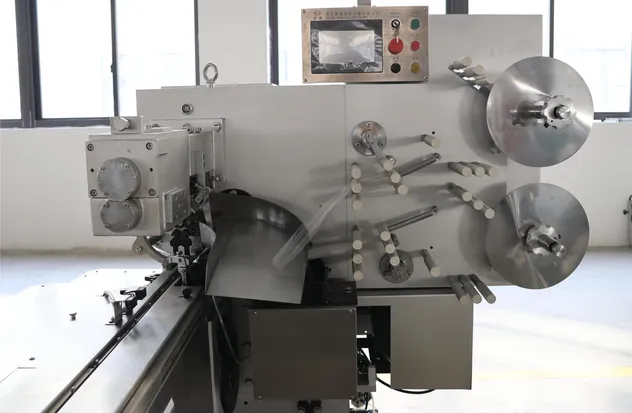
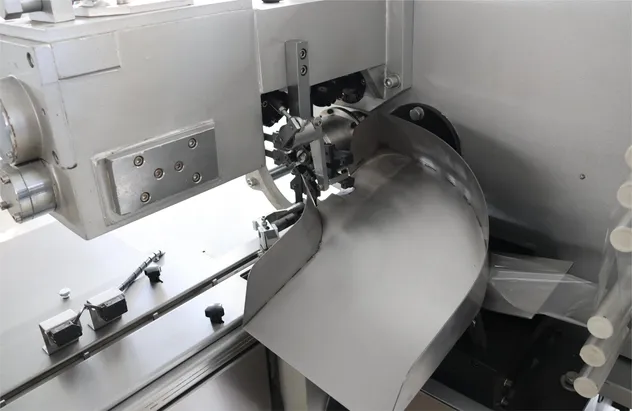
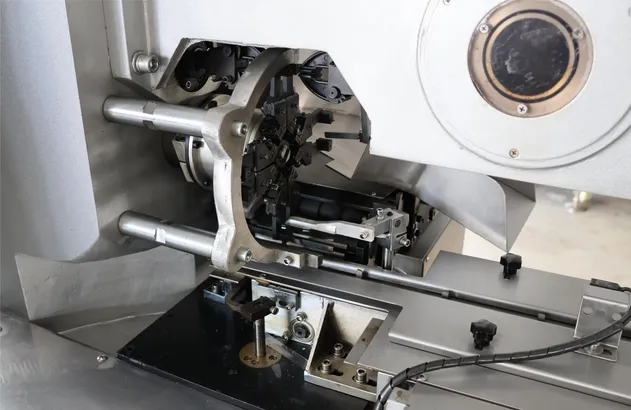
The dual-film wrapping system is the JY-LS800's most technically sophisticated feature. Two independent film paths — one for the inner wrap and one for the outer wrap — are serviced by separate film roll carriages, tension control systems, and cutting stations. The inner wrap is typically a thin (15–25 micron) wax paper or aluminum foil laminate that is applied directly to the product surface, providing a food-contact-safe barrier. The outer wrap is typically a 20–35 micron printed BOPP or metallized film that provides the branded presentation. Both wraps are gathered and twisted at the product ends simultaneously, with the inner twist nestling inside the outer twist to create a clean, professional finish. The twist tightness — which determines both package appearance and seal effectiveness — is independently adjustable for each film layer through the HMI, allowing operators to balance visual presentation against material cost (tighter twists consume more film length per package).
3. Product Inspection and Auto-Reject System
The integrated product inspection system operates at full production speed, evaluating every product before it enters the wrapping station. High-resolution optical sensors check for product presence, dimensional conformance against recipe parameters, and surface defects including cracks, chips, and discoloration. Products that fail inspection are diverted via a high-speed pneumatic gate before reaching the wrapping station, ensuring that only conforming product is wrapped. Additionally, the wrapping process itself is monitored: sensors verify that both inner and outer films are present and correctly positioned, that twist actuators have completed their cycle, and that the finished wrapped product has exited the machine. Any wrapping failure — a missed film, an incomplete twist, a jam — is detected within a single machine cycle, and the affected wrapping station is automatically paused while the others continue operating. This station-level fault isolation is a key contributor to the machine's 100% packaging rate under normal conditions.
4. High-Capacity Feeding and Distribution System
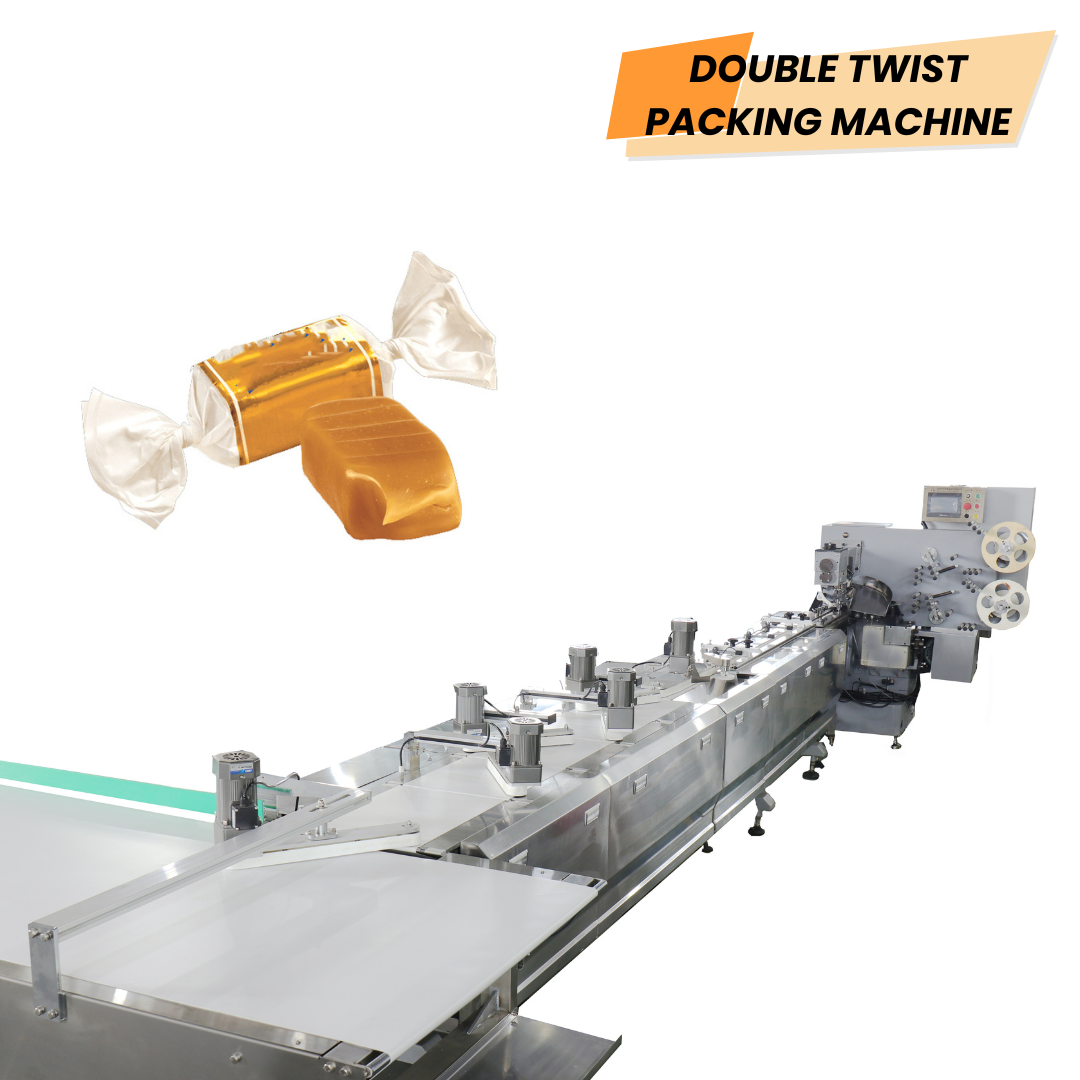
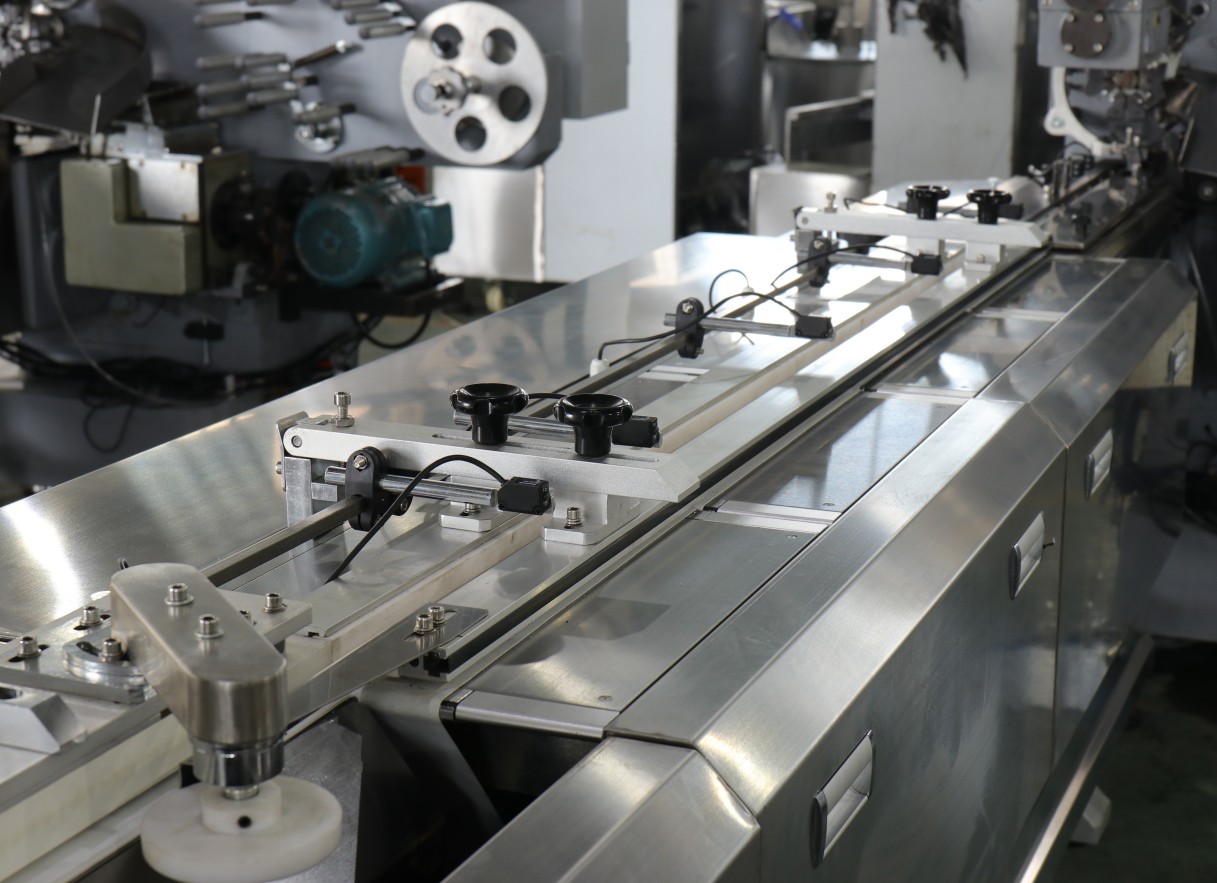
The JY-LS800's size — over 6.3 meters in length — accommodates a sophisticated product feeding and distribution system. Products are loaded into a large-capacity hopper at the machine's input end and are individually singulated and oriented by a series of vibratory tracks and rotary feeders. The distribution system delivers product to multiple wrapping stations arranged in parallel, multiplying throughput without requiring multiple independent machines. The system handles products with dimensions from 12 to 42 mm in length, 15 to 30 mm in width, and 6 to 25 mm in height — a range that covers the most common individually wrapped candy, chocolate, and nougat formats. Feed rate to each wrapping station is independently controllable through the HMI, allowing operators to balance the production load across stations and compensate for any station taken offline for maintenance or fault recovery.
5. Twist Tension and Appearance Control
The quality of a double twist wrap — its visual appeal and functional integrity — depends critically on the consistency of twist tension applied to both film ends. Too little tension produces loose, unraveling twists that fail to seal the product. Too much tension tears the film or creates an unattractive, overly compressed appearance. The JY-LS800's servo-controlled twist actuators apply precisely calibrated torque to each twist, with tension values stored in the product recipe and maintained consistently across hundreds of thousands of wrapping cycles. The twist actuators incorporate a feedback loop that monitors the twist resistance during each cycle and adjusts the applied torque to compensate for film batch variations, ambient humidity changes that affect film pliability, and gradual wear on the twisting fingers. This adaptive control is unique to the JY-LS800's servo architecture and cannot be replicated by purely mechanical twist systems.
6. Robust Industrial Construction for Continuous Production
At 2,800 kg, the JY-LS800 is built for the demands of round-the-clock confectionery production. The main frame is fabricated from heavy-gauge 304 stainless steel with a reinforced base that dampens vibration across the machine's full 6.3-meter length. All drive components — bearings, gears, belts, and actuators — are sized for a service life exceeding 20,000 operating hours under normal load conditions. The electrical system is housed in IP54-rated enclosures with forced-air cooling for the servo drives, which generate significant heat during sustained high-speed operation. The machine draws 8.5 KW at full production speed, with power distributed across the multiple servo axes, heating elements for temperature-controlled film handling (where required), and auxiliary systems. Despite its size and power, the JY-LS800 operates within 75 dBA at the operator position, meeting occupational noise exposure standards for continuous-shift operation.



 EN
EN