 EN
EN
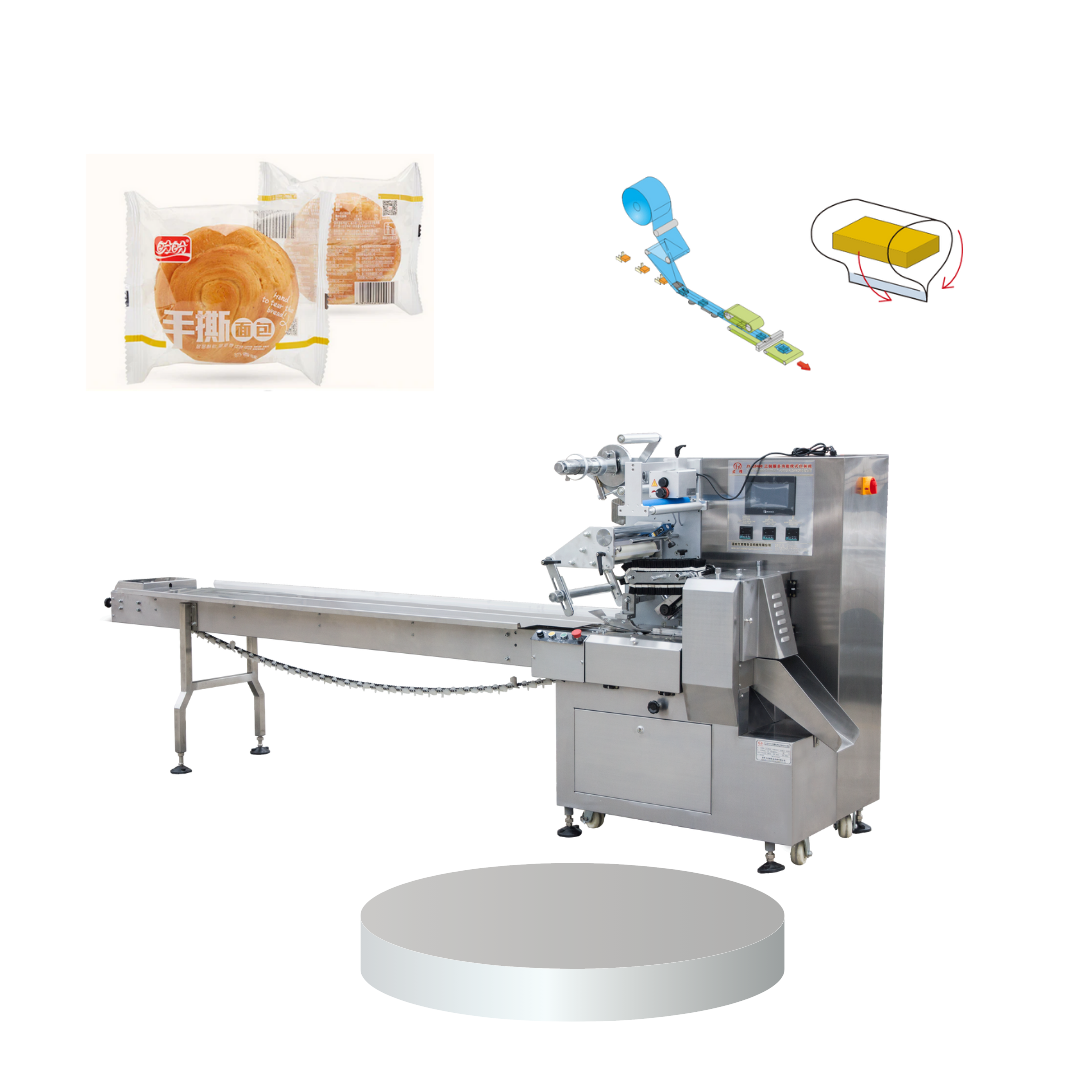
Adaptive Mechanical Design for Variable Product Sizes
Conveyor Speed and Infeed Timing Adjustments for Size Transitions
A flow packing machine must handle rapid changes in product dimensions without stopping the line. Photoelectric sensors detect the leading edge of each item, feeding real-time data to a programmable logic controller (PLC). When product size shifts—say, from a short snack bar to a longer biscuit—the PLC instantly recalculates conveyor speed and infeed timing. The belt accelerates or decelerates to maintain consistent spacing between products, preventing jams and ensuring precise entry into the forming tube. For bakers switching from small cookies to large pastries, this transition occurs seamlessly within seconds—no manual reconfiguration is required. The result is reduced changeover time, lower film waste, and sustained throughput across mixed-size production runs.
Bag Length Customization via Servo-Driven Sealing & Cutting
Modern servo-driven sealing and cutting systems eliminate mechanical limitations on bag length variability. Unlike legacy gear-based setups that demand downtime for adjustments, servo motors receive dynamic commands directly from the controller. As taller bottles or longer confectionery items pass through, the system adjusts jaw rotation speed and cut position in real time—producing bags precisely matched to product length, from ultra-short pouches to elongated formats. This continuous, stop-free adaptation removes the need for manual bag-length selection or tooling swaps. High repeatability ensures consistent cut tolerance across frequent size changes, supporting both high-speed production and agile small-batch operations. For manufacturers managing diverse SKUs, this capability translates directly into faster changeovers, less film waste, and greater packaging flexibility.
Gentle, Precision Handling of Irregular and Fragile Products
A flow packing machine must adapt its handling methods when products vary in shape, rigidity, and delicacy. Irregular items like flatbreads or leafy greens require gentle yet precise motion to avoid tearing or crushing. Modern machines achieve this through specialized mechanical systems that minimize direct contact and adjust forces in real time—ensuring product integrity without sacrificing speed or consistency.
RPI (Rotary Jaw Inverted) Technology for Flatbreads and Leafy Vegetables
Rotary Jaw Inverted (RPI) technology reorients the sealing jaws to face upward instead of downward, allowing flat, flexible products—such as tortillas or spinach leaves—to enter the packaging zone fully supported and uncompressed. The rotary motion synchronizes with conveyor speed, enabling seamless sealing while maintaining full underside support. By eliminating abrupt clamping and folding, RPI reduces distortion, minimizes jams, and delivers uniform wrap quality—even for the most pliable items. Operators transitioning from conventional horizontal form-fill-seal machines consistently report lower waste and improved uptime.
Vacuum Belts, Low-Pressure Air Gates, and Foam-Clad Guides
Fragile goods—including pastries, fresh herbs, and glass vials—require soft-touch transport solutions. Vacuum belts hold products gently in place without friction-induced damage. Low-pressure air gates decelerate items smoothly before sealing, replacing harsh mechanical stops with a controlled air cushion. Foam-clad side guides absorb lateral impacts and prevent scuffing or abrasion. Together, these components preserve surface integrity and structural stability throughout the packaging cycle. Because settings like vacuum level, air pressure, and guide clearance are software-adjustable, changeovers between fragile product types take minutes—not hours—enhancing responsiveness without compromising protection.
Specialized Architectures for Challenging Geometries and Weights
Flow packing machines face unique engineering challenges when handling oversized, top-heavy, or irregularly shaped items—especially those exceeding standard weight thresholds. Conventional conveyor-fed architectures often fail under such conditions, necessitating purpose-built mechanical solutions that prioritize stability, control, and scalability.
Zebra Inverted Box Motion for Large, Unstable, or Heavy Items
The Zebra Inverted Box Motion architecture addresses these extremes by reversing the packaging sequence: instead of pushing products horizontally into a forming tube, it lowers them vertically into a pre-formed bag from above. This inverted approach eliminates tipping risks for tall, narrow, or top-heavy items—such as industrial components, artisanal loaves, or dense root vegetables. Lateral stabilization guides further prevent shifting during descent, accommodating wide or asymmetrical geometries. With load capacity exceeding 50 lbs (22.7 kg) and configurable sealing pressure zones, the system maintains seal integrity across variable weights and shapes. Its modular guide systems allow rapid adaptation to new product profiles—making it a robust solution for applications where conventional flow packers fall short.
Compact and Scalable Flow Packing Machine Solutions for SMEs
Small and medium-sized enterprises (SMEs) benefit significantly from compact, modular flow packing machines engineered for operational agility and cost efficiency. Entry-level models reliably handle up to 175 packages per minute—sufficient for startups, contract packagers, or seasonal producers. These systems prioritize quick-change tooling, intuitive HMI interfaces, and embedded software that automates size transitions—reducing operator dependency and training overhead. Energy-efficient drives and low-maintenance designs further lower total cost of ownership. Crucially, their scalable architecture allows businesses to begin with core functionality and add capabilities—like advanced vision inspection or integrated weighing—as demand grows. This phased investment model delivers consistent packaging quality, competitive throughput, and strong ROI—enabling SMEs to scale confidently without overcommitting to oversized automation.
FAQ
Q: How does a flow packing machine adjust for varying product sizes?
A: Flow packing machines use sensors and programmable logic controllers (PLCs) to detect product dimensions and adjust conveyor speed and infeed timing in real time. These systems enable instant transitions without requiring manual reconfiguration.
Q: What benefits do servo-driven sealing and cutting systems offer?
A: Servo-driven systems allow dynamic adjustments to bag length without needing downtime. This results in faster changeovers, less material waste, and precise bag-length customization for diverse products.
Q: How do flow packing machines handle fragile or irregularly shaped products?
A: Flow packing machines use advanced technologies like RPI (Rotary Jaw Inverted) systems, vacuum belts, low-pressure air gates, and foam-clad guides to handle delicate or irregularly shaped goods gently and precisely.
Q: What is the Zebra Inverted Box Motion architecture?
A: The Zebra Inverted Box Motion system reverses the packaging process to lower products into bags vertically, making it ideal for heavy, tall, or unstable items. It ensures stability, scalability, and seamless sealing for challenging geometries and weights.
Q: Are there flow packing solutions suited for small and medium-sized enterprises (SMEs)?
A: Yes, compact and modular flow packing machines cater specifically to SMEs, offering scalable architectures, quick-change tooling, intuitive interfaces, and cost efficiency while maintaining high throughput.